Doublebase Dry Skin Emollient
4.6 stars
4.6 stars


Clinically proven, moisturising emollient for problem dry skin
Designed to manage dry, itchy, and eczema-prone skin, it hydrates by replenishing lost moisture while creating a protective barrier to prevent further water loss. Suitable for everyday use, it soothes irritation while restoring the skin’s natural softness and flexibility. Dermatologically tested and non-greasy, Doublebase Dry Skin Emollient provides effective relief and long-lasting skin protection for all ages.
- Original prescription formula
- Free from SLS and parabens
- Easily absorbed
Doublebase Dry Skin Emollient | Instructions for Use
- If you require a previous version of the leaflet (Instructions For Use) please contact us.
How to use
Doublebase Dry Skin Emollient
This product is only for application to the skin
Available in a 100g tube, for added convenience when out and about, and as a 250g pump pack. Before using the 250g pack, turn the top of the pump dispenser in the direction of the open arrow to unlock it. After unlocking for the first time, you will need to press down the pump dispenser several times to prime the pump before any gel is dispensed.
For maximum benefit you should:
Apply Doublebase Dry Skin Emollient to the affected areas of the skin as often as required - usually 2-4 times a day after washing, when the skin is most prone to dryness.
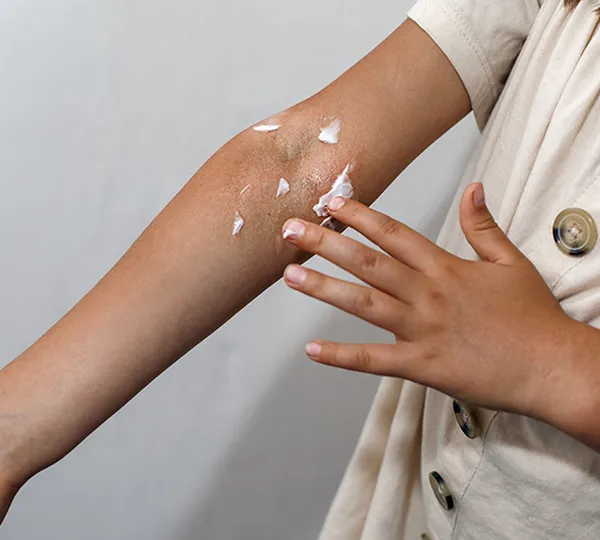
Use a few gentle strokes to smooth the gel across the skin in the same direction as hair growth (like stroking a cat or dog). If necessary, allow time for any excess to soak in. Do not rub the skin vigorously.
This product can also be used before and after washing, showering or having a bath to help condition the skin and stop if from drying further.
If you are applying another treatment to the same areas of skin as Doublebase Dry Skin Emollient, try to avoid mixing the two products. This can be achieved by applying the treatments alternately, leaving sufficient time to allow the previous application to soak in.
If you forget to use Doublebase Dry Skin Emollient
Don’t worry if you occasionally forget to use it, just carry on using the gel as described the next time you require it.
Product Information
-
WHAT DOUBLEBASE DRY SKIN EMOLLIENT IS AND WHAT IT IS USED FOR
- Doublebase Dry Skin Emollient is a highly moisturising and protective emollient gel for application to your skin.
- It helps treat dry or chapped skin conditions that may also be itchy, red and sore. Common examples include:
- Psoriasis (scaly, pink patches of skin)
- Elderly pruritus (itchy skin due to ageing)
- Ichthyosis (abnormal scaly skin)
- Various forms of eczema, dermatitis and other dry skin disorders
- All age groups can use Doublebase Dry Skin Emollient, including infants.
- The therapeutic ingredients in this product are isopropyl myristate and liquid paraffin.
- These emollient oils help to:
- Soften, moisturise and protect your skin by trapping moisture in the skin and restoring the normal protective function of the skin
- Prevent the skin-drying and irritant effects that can be caused by washing and bathing and by the soaps, foaming additives and fragrances used in ordinary cleansing products
- This product can be used in addition to any other emollients or treatments your pharmacist, nurse or doctor may have given or prescribed for you to treat your dry skin condition.
-
- Keep out of the sight and reach of children.
- Do not use Doublebase Dry Skin Emollient after the use-by date shown on the container. The use-by date refers to the last day of that month.
- Do not store above 25°C.
- Do not freeze the product.
- After using the 250g pack, it is advisable to lock the pump by turning it in the direction of the stop arrow. In the case of the tube, replace the cap after use.
- Occasionally, in the 250g pack, a small pocket of air may form around the bottom end of the pump's dip tube, making it harder to pump the gel out. This may be resolved by tapping the base of the bottle firmly on a hard surface two or three times, so the gel can settle at the bottom around the end of the dip tube. The pump should then be pumped slowly.
-
BEFORE YOU USE DOUBLEBASE DRY SKIN EMOLLIENT:
Do not use Doublebase Dry Skin Emollient if you are allergic (hypersensitive) to isopropyl myristate, liquid paraffin or any of the other ingredients listed in Section 6 of the Instructions for Use.
Using medicines
This product is not known to interact with medicines taken orally at the same time. It can also be used in addition to any other emollients or applied treatments your doctor, nurse or pharmacist may have given or prescribed for you to use to treat your dry skin condition. If you are using other topically applied products, follow the instructions below to avoid diluting the other product and spreading it to areas that do not need it.
Pregnancy and breast-feeding
This product can be used during pregnancy and while breast-feeding. The ingredients have been in widespread use in this and similar preparations for many years, without reports of problems. However, safety trials have not been conducted.
Important Safety Information
Do not smoke or go near naked flames - risk of severe burns. Fabric (clothing, bedding, dressings etc) that has been in contact with this product burns more easily and is a serious fire hazard. Washing clothing and bedding may reduce product build-up but not totally remove it.
Possible side effects
Doublebase Dry Skin Emollient has been specially designed for use on dry or problem skin. However, in rare cases it can cause skin irritation (mild rashes) or allergic skin reactions on extremely sensitive skin. These rare effects tend to occur during or soon after the first few uses.
Stop using this gel and tell your pharmacist, nurse or doctor:
- if your skin condition seems to look or feel worse
- if any of the side effects get serious, or you notice any other side effects not mentioned in this leaflet
If this product is accidentally swallowed, its oily ingredients may cause diarrhoea. If this happens:
- treat the symptoms as you would deal with any case of diarrhoea;
- drink plenty of water;
- do not attempt to cause vomiting.
Reporting of side effects
If you get any side effects, talk to your pharmacist, nurse or doctor. This includes any possible side effects not listed in the Instructions for Use. You can also report side effects to the Manufacturer (see Section 6 of the Instructions for Use). By reporting side effects, you can help provide more information on the safety of this product.
-
What Doublebase Dry Skin Emollient contains:
- The therapeutic ingredients are isopropyl myristate and liquid paraffin. The other ingredients are glycerol, carbomer, sorbitan laurate, trolamine, phenoxyethanol and purified water.
What Doublebase Dry Skin Emollient looks like and contents of the pack:
- The gel is available in a plastic tube containing 100g or a plastic pump pack containing 250g.
- The product has the appearance of a white gel. It contains no steroids, perfume, colourings, SLS, parabens or MI preservatives.
The Manufacturer is Diomed Developments Ltd, Tatmore Place, Gosmore, Hitchin, Herts, SG4 7QR, UK.
Frequently Asked Questions
-
Eczema and dermatitis are often used interchangeably to describe a group of commonly occurring skin conditions that causes itchy skin. They affect up to 1 in 5 children and 1 in 12 adults. The signs and symptoms vary, but can include making the skin dry, red, hot and itchy. It can affect any part of the body, although it most commonly appears on the hands, insides of elbows and behind the knees. It can also become inflamed, leading to additional redness and irritation during ‘flare-ups’.
-
No, eczema and dermatitis are not contagious. You, or your children, can't catch eczema by coming into contact with someone with the condition. However, if you aren't sure about your diagnosis, we recommend you check this with your doctor or pharmacist to rule out other skin problems that can be infectious or contagious.
-
Psoriasis is a long-term scaling skin disease that affects 1 in 50 people. It occurs equally in men and women and can start at any age. Psoriasis is a long-term condition which may come and go throughout your lifetime. Symptoms include raised silvery patches of skin which have distinct red edges. It does not usually scar the skin, although sometimes it can cause a temporary increase or reduction in skin colour. The outer layer of skin (the epidermis) contains skin cells which are continuously being replaced. This process normally takes between 3 and 4 weeks. Psoriasis causes skin cells to divide quicker, so that cells are both formed and shed in as little as 3 to 4 days. Infections, stress, damage to the skin, alcohol, and sometimes intense sunlight may trigger flares of psoriasis. For more information click here.
-
No, psoriasis is not contagious. You, or your children, can't catch psoriasis by coming into contact with someone with the condition. However, if you aren't sure about your diagnosis, we recommend you check this with your doctor or pharmacist to rule out other skin problems that can be infectious or contagious.
-
Ichthyosis is a rare skin condition that causes the skin to become unusually dry, thick and scaly, often from birth or early childhood. The name comes from the Greek word ichthys, meaning ‘fish’, because the skin can sometimes resemble fish scales. It happens when the skin doesn’t shed its cells properly, leading to a build-up that can feel tight, rough or flaky. While there’s no cure, daily care can make a big difference, helping the skin feel softer, smoother and more comfortable.
-
No, ichthyosis is not contagious. Most forms are genetic, meaning they’re inherited and can’t be passed from one person to another through touch, contact or sharing items.
-
Emollients are medical moisturisers which help to prevent water loss from dry skin. Emollients contain oils which work by replacing natural oils in the skin – helping to repair the skin’s natural protective barrier against irritants. Sometimes they also contain ingredients called humectants, which help to hold water in the skin.
-
Yes, emollients are recommended as first line treatment for all dry skin conditions. Rarely, individuals can be allergic to an ingredient. So, as with any product, it’s a good idea to check ingredients, in case there are any that you may be concerned about.
-
Dry your hands thoroughly after washing. After washing or sanitising, immediately apply an emollient to trap moisture in the skin, replace lost oils and to restore the skin’s natural protective barrier. Use a soap substitute instead of normal hand cleansers, particularly one that contains moisturising ingredients to help restore the skin’s natural barrier property. A moisturising soap substitute with an added antibacterial agent such as chlorhexidine or benzalkonium chloride can also be beneficial for cracked skin where there is a risk of skin infection.
-
Emollients should generally be applied frequently throughout the day. The most suitable interval will vary between different products and different individuals. In some cases, it may vary as the skin conditions vary. As a general rule, emollients should be re-applied as often as necessary to keep the skin feeling moisturised. Sometimes emollients alone are not enough to control eczema and psoriasis, particularly in more severe cases. Additional treatments eg topical steroids may be necessary under these circumstances, in addition to emollients.
-
Yes, although rare individuals can be allergic to any ingredient. So, as with any product, it’s a good idea to check ingredients, in case there are any that you may be concerned about. As with any oily product used in large quantities and applied repeatedly over long periods, build-up of dried residue on clothing, bedding and dressings may make these materials more flammable. If using these products, do not smoke or go near naked flames. As a precaution, dressings and clothing should be changed and washed frequently.
-
Many soaps, hand washes, shampoos, body washes and laundry products contain ionic detergents and surfactants. It’s what makes them foamy. These ingredients can be highly irritant for people with problem dry skin. One of the worst culprits is SLS (sodium lauryl sulphate) which can strip the skin’s natural oils, making problem dry skin worse.
-
Yes. Dry Skin is available without a prescription. You’ll find it in the Dry Skin & Eczema fixture in Boots, and the healthcare section of all good supermarkets, pharmacies and retailers. Dry Skin is also available online at Amazon.co.uk
-
Dry Skin can be used daily by adults, children and infants.
-
Dry Skin can be used during pregnancy and while breast-feeding. However, safety trials have not been conducted. When breast-feeding, if use on the nipples is necessary, apply sparingly and after feeds. Gently wipe away any remaining product before feeding your baby.
-
Dry Skin does not contain any products of animal origin and has not been tested on animals.
-
Dry Skin has not been tested on animals.
-
Dry Skin is available in both 250g pump bottles and 100g tubes.
-
Please see our 'Where to buy' page. You’ll find a list of retailers who stock the Doublebase range and links to where you can buy it online.
-
Dry Skin has been designed specifically for problem dry skin, which can often be sensitive. It has been clinically proven and tested on dry skin conditions such as eczema, dermatitis and psoriasis. However, as with all products, rare individuals can be allergic to any ingredient. If irritation occurs, stop using the product and ask your pharmacist or doctor for advice.
-
The ingredients in Dry Skin are: Isopropyl myristate, liquid paraffin, glycerol, carbomer, sorbitan laurate, trolamine, phenoxyethanol, purified water.
Compare Doublebase Products
Find which Doublebase product is right for you:

|

|

|

|
|
|---|---|---|---|---|
| Customer Reviews | 4.5 stars |
4.5 stars |
4.5 stars |
4.3 stars |
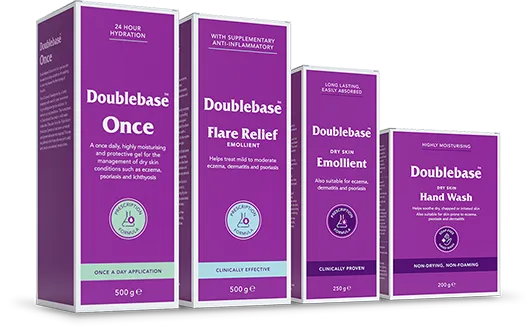
| Sizes Available | 100g Tube & 250g Pump | 100g Tube, 250g Pump and 500g Pump | 100g Tube & 500g Pump | 200ml Pump |
| RRP | £6.99 / £9.99 | £8.49 / £17.99 | £9 / £19 | £7.99 |
| Suitable from Birth | Yes |
From 1 year | Yes |
Yes |
| Ideal for | Every day use as often as required. Original prescription gel formulation. | To treat and prevent flare-ups. Contains a supplementary anti-inflammatory. | Once daily application. For school children, the elderly and adults who may struggle to reapply emollients throughout the day. | For frequent hand washing as a soap substitute. Soap free formula. |
| Eczema/ Dermatitis | Yes |
Yes |
Yes |
Yes |
| Psoriasis | Yes |
Yes |
Yes |
Yes |
| Ichthyosis | No |
No |
Yes |
No |
| Free from steroids, fragrances, SLS, parabens and MI preservatives | Yes |
Yes |
Yes |
Yes |
The Doublebase difference
Our Dry Skin formula combines the high oil content of an ointment with the easy absorption of a cream, all within a gel format. It also contains the humectant glycerol, helping to soften, moisturise and protect the skin by trapping moisture and supporting its natural protective barrier.
Dry Skin’s innovative gel formulation breaks down when it comes into contact with natural salts in the skin; meaning it’s easily absorbed into the stratum corneum (top layer of skin) and provides a lasting, protective barrier of oils, even after gentle washing.
Buy Online
Wherever you shop, Doublebase is close at hand for the care your skin needs.
Tried, tested, trusted.
Hear what our customers have to say about Doublebase products.